

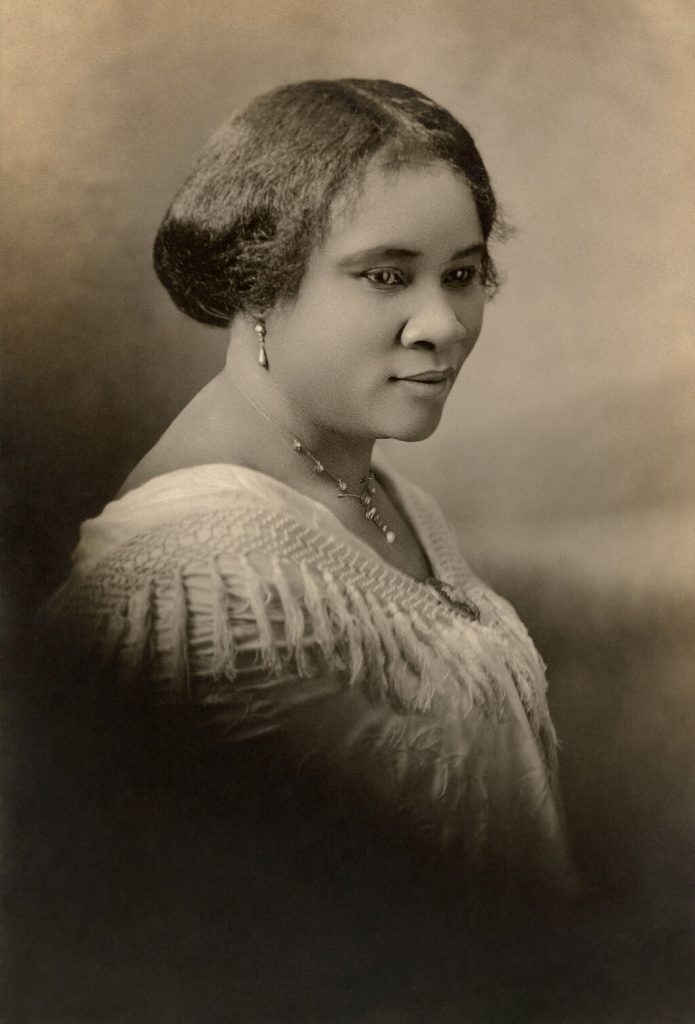
If Madame C.J. Walker were alive today, her story would resist the version we like to tell. There would be no tidy journey, no neat stages, no moment of doubt after which everything falls into place. It would not translate into a narrative about patience rewarded at the end. Walker moved faster than the order we are used to could accommodate.
Success that arrives too directly always triggers resistance, especially when it turns quickly into money and real influence. History prefers winners who can be broken down into safe, digestible parts. Poverty first, effort next, approval at the finish line. Walker offered none of that comfort. Results came before consent.
Her story brings no relief. It does not soothe the conscience. It does not confirm that the world is fair, only slow. What it reveals is far harder to accept. Effectiveness can be ugly. Success does not always come in a form that makes everyone feel good.
It does not begin with a dream. It begins with a problem no one wants to touch
She was born in 1867 as the first free child in a family of formerly enslaved people. “Free” here is a technical term. In reality, she was quickly left on her own, without backing, without protection, without a place where anyone was prepared to listen. She worked with her body, washing other people’s clothes, living in a world where the body of a woman in her position was a tool, not a subject. When her hair began to fall out, there was no language for it, no sympathy, no interest. There was shame and silence. A problem pushed so far down it ceased to exist in public.
This is not a pretty beginning.
That is precisely why it cannot be ignored.
Walker did not search for meaning in what happened to her. She did not try to turn it into a story about strength of character or inner transformation. She looked for a solution. The question was not who am I, but what can be done with what is at hand and what clearly does not work. Illness did not become a metaphor. It became a starting point.
Most contemporary stories would end here, because we enjoy the stage of awakening, self-discovery, the decision to change one’s life. We like narratives where a problem leads to enlightenment. Walker did not experience enlightenment. She identified a market. She saw scale, repetition, unmet demand. Instead of asking what it said about her, she checked what it said about demand.
Some will argue that Walker was not first. Annie Malone recognised the problem earlier and built a functioning product. The difference lay elsewhere. Walker did not stop at a solution. She understood that outcomes are decided not by innovation alone, but by scale, distribution, and the speed of market capture. So no, she was not first. She was better.
This is the moment her story becomes uncomfortable. It does not move through emotion, but through logic. It builds no tension around identity, only around results. It shows that a starting point does not need to be clean or inspiring to support something much larger. It only needs to be real.
When the game belongs to someone else, you learn it better than its owners
The first money brought no joy. It brought orientation. Walker quickly understood that she was not selling a product in a vacuum. She was selling within a world governed by rules written by others. Trade, distribution, capital were already occupied territory. The table belonged to white men who set prices, channels, and hierarchies of importance. She was not invited and had no intention of waiting.
Rather than forcing her way in on their terms, she built a parallel route. She did not compete head-on with those who controlled the market. She went around them. Her focus shifted to customers no one considered worth the effort. Women whose needs were excluded from the official economy. Where others saw a margin, she saw volume.
That move altered the balance of power, not because it was spectacular, but because it worked. Every product sold meant money bypassing their hands. Every new saleswoman added another point of distribution beyond their control. This was not performative rivalry. It was quiet territorial takeover.
Walker grasped something else very quickly. Winning someone else’s game requires more than knowing the rules. Those rules must be replicated faster, cheaper, and on one’s own terms. She trained women the way sales professionals are trained, not the way protégées are nurtured. Counting money. Planning the day. Speaking to customers without apology or embarrassment. Closing the sale. Moving on to the next client. The next transaction.
This was the point at which she stopped being an exotic exception and became competition. Not symbolic, but financial.
Money circulating within this network did not flow into banks controlled by the same people. It went directly into the hands of women who had never had access to any negotiating table. Cash alters perspective faster than any ideology. It changes how one speaks, how one refuses, how one draws boundaries.
Here is where Walker truly began to win. Not because she was accepted, but because she stopped needing acceptance. The game continued, but no longer solely on rules written by those seated at the main table.
She built her own.
Success without a debrief
Winning does not end the game.
It only changes its temperature.
In Walker’s case, money arrived before acceptance. Influence preceded approval. The system functioned, the network expanded, sales closed, yet no moment arrived when someone said: now you belong here. There was no rite of passage. No point at which the table suddenly became shared.
This is a cost rarely discussed, largely because it resists easy naming. Walker was needed but unwanted. Useful yet inconvenient. Admired from a distance, tolerated conditionally. Her success was not erased, but neither was it fully acknowledged. Silence replaced ceremony. A gap replaced belonging.
Power acquired outside the official order receives no certificate of authenticity. Even when the numbers add up. Even when results are visible. Walker won someone else’s game without being invited to comment on it. She never became part of the establishment. She became an exception best kept on a separate shelf.
Here most success narratives fracture. We are taught that going far enough will prompt the world to adjust. Walker shows the opposite. Distance travelled does not guarantee belonging. Money can exist without legitimacy. Power can shift without social recognition.
This absence of debrief is not personal tragedy. It is mechanism. Systems do not reward those who exploit their rules too efficiently. They attempt to domesticate them, neutralise them, or reduce them to curiosities. Walker resisted reduction. Her presence remained difficult to tolerate.
Success that refuses permission forces confrontation. It exposes whether rules are neutral or merely well-packaged. It reveals whether the table was ever open or only appeared so. These are questions no one enjoys hearing from a winner.
The price Walker paid had nothing to do with lack of money or influence. It took the form of having no place where success could rest without tension. No moment where achievement stopped being perceived as threat. Life unfolded in the space between victory and acceptance that never arrived.
This is not a cost self-help manuals teach.
It cannot be turned into advice.
The table still stands
That table was never neutral. From the outset it belonged to white men who wrote the rules, distributed capital, and decided who qualified as a player. Everyone else waited, adapted, or disappeared.
Madame C.J. Walker met none of the entry requirements. She was a woman. She was Black. She came from a place the system recognised only as cheap labour and other people’s problems. She had no name, no connections, no patience for waiting until her presence felt appropriate.
So she did not pull up a chair.
She built her own table.
This is the point that truly stings. Not success itself, not money, not scale. What hurts is where it happened. She took rules written by white men and used them better than they did. Without permission. Without gratitude. Without pretending the goal was anything other than results.
This was not a fight for representation. It was an operation on capital. Money began circulating beyond their reach. Influence moved into spaces previously ignored. Women meant to remain invisible started counting, selling, deciding. Not in theory. In practice.
Systems do not forgive this.
That is why Walker is still packaged in a safe version today. A pioneer. An inspiration. An exception no longer threatening. Methods are glossed over because they expose how fragile power becomes when people stop asking for access.
This text is not about whether the world treated her fairly. It did not, and that is no revelation. It is about what happens when someone enters another person’s game and wins on her own terms, without any intention of apologising for poor manners.
The table still stands.
The rules are still written by the same people.
The difference lies in the fact that once, someone showed how easily they can be bypassed.
That is the only lesson this system truly wants forgotten.