

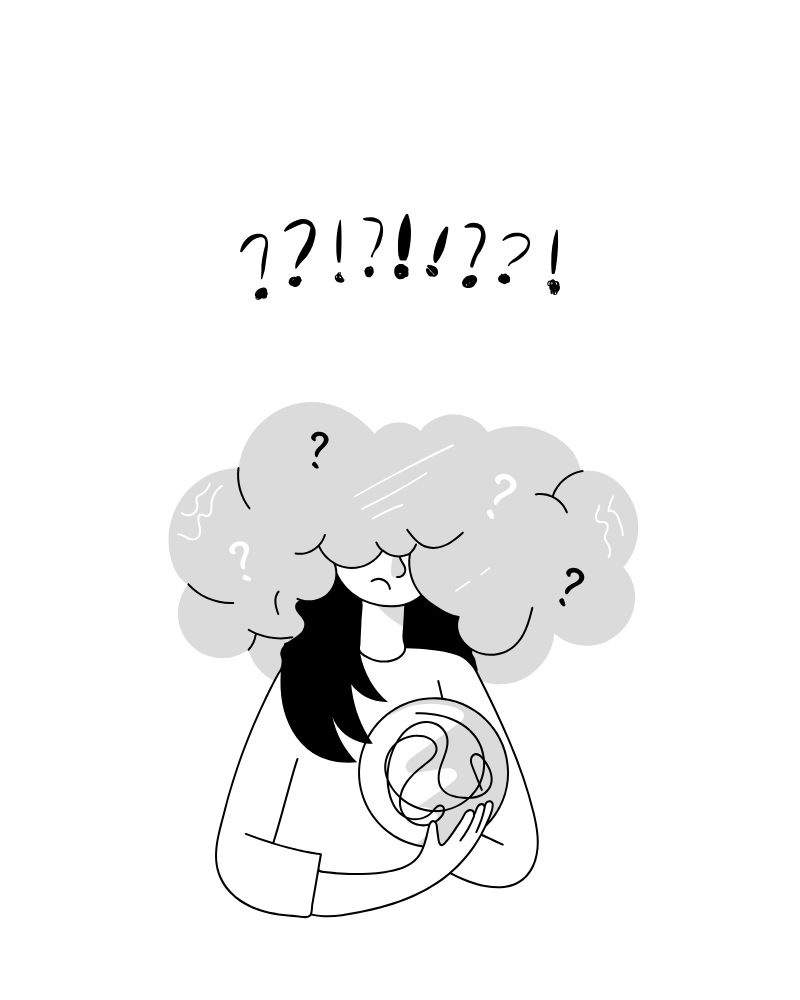
Most women grow up believing their minds are loud, intense, sensitive. Simply overwhelming. From an early age, they are told to calm down, to stop analysing, to stop asking why. In ancient times, this mental intensity was seen as a gift. Priestesses, healers and oracles were chosen for their restless minds. Their thoughts spiralled, stretched and made connections others failed to see. What some now call a flaw was once recognised as a doorway.
Today the word overthinking carries the weight of pathology. It suggests malfunction, obsession, fear. But perhaps the real problem is not the thinking itself. It is the direction. A mind without direction becomes a storm that turns against you. A mind with direction becomes a force. Overthinking is not the enemy. Unaimed thinking is.
The Labyrinth
Every civilisation used the symbol of a labyrinth to represent the human mind. The Greeks placed one under the palace of Knossos. The Egyptians carved them into tombs. Mystics in India saw the mind as a thousand-room palace. The labyrinth was never designed to trap. It was designed to teach the seeker how to walk through complexity without drowning in it.
When your thoughts spiral, you are not malfunctioning. You are entering the labyrinth. The danger is not the depth. It is losing the thread. Modern research on rumination shows that people overthink when they have no internal anchor. The mind keeps searching because it has not found meaning. Add cultural pressure to stay quiet and you get a woman who thinks too much but uses none of it.
Yet once you understand the labyrinth, everything changes. A spiral becomes a map. A loop becomes a signal. A thought becomes a doorway.
The Ancient Mind
In early Greek philosophy, the term phronesis described a form of practical wisdom that came from thinking deeply and often painfully. It was not the calm wisdom of the elder. It was the sharp wisdom of the woman who has lived, observed and survived. Ancient texts rarely warned against thinking too much. They warned against thinking in the wrong direction.
The Stoics advised the mind to examine itself. Hermetic texts urged the seeker to question without fear. Early Christian mystics believed overthinking was a sign the soul was trying to surface. These cultures viewed the restless mind not as an illness but as a threshold. If you reached that threshold, you were close to understanding something you had avoided.
Modern psychology agrees more than it admits. Studies on introspection show that deep thinkers spot patterns faster. They process emotional information with greater nuance. They make meaning where others make excuses. The issue is focus. Not thinking.
The Modern Brain
Neuroscience reveals that an active mind is not a chaotic one. MRI scans show that people who think intensely activate networks associated with problem solving, creativity and emotional processing. The same neural fire that can fuel anxiety can also fuel insight. The direction determines the outcome.
Rumination looks identical to analysis in the brain. The only difference is purpose. Rumination circles the wound. Analysis studies it and moves forward. The mind does not need silence to function well. It needs intention.
Women especially experience this duality because their brains maintain stronger interhemispheric connections. The right side feels. The left side interprets. The bridge between those worlds is wider. This creates emotional intelligence and intuitive logic. It can also create storms if the signals have nowhere to go.
Therefore, aiming the mind is not a poetic idea. It is a neurological necessity.
The Archer
In mythology the archer represents a mind that knows its direction. Artemis. Diana. Sagittarius. All symbols of focus. The bow is the mind. The arrow is the thought. Tension is required. Precision is essential. Release is intentional.
Overthinking becomes power the moment the mind is treated like an archer treats her aim. Attention is placed with intention. Meaning is chosen, not inherited. A spiral becomes a descent or a breakthrough depending on how it is held.
Most women let thoughts fall wherever they land because they were never taught to direct them. They were taught to distract themselves, soothe themselves or silence themselves. None of these methods work. Not long term. The archer does not mute her arrow. She aims it.
The Turning Point
There is always a moment when the mind crosses from curiosity into fear. This is the turning point. Ancient teachers called it the gate. Modern therapists call it cognitive overload. Either way, the sensation is the same. The thoughts speed up. The heart tightens. The world narrows.
This moment is not a warning. It is an invitation. Your mind is signalling that you have reached a place that requires action, not avoidance. You can drown in the sensation or you can follow the signal. Action breaks the loop. Thought without action traps you inside it.
Once you recognise this pattern, you stop fearing your mind. You start navigating it. The gate becomes familiar. You walk through it instead of turning back.
The Practice
To aim your mind, you do not need rituals, notebooks or perfect mornings. You need three practices that ancient seekers and modern psychologists share.
The question
Every spiral begins with a feeling. Ask the mind what it is trying to solve. Not what it fears. Not what it predicts. What it wants to understand. You give the spiral a centre.
The anchor
Choose a focus. A single sentence. A truth. A direction. Without an anchor, the mind drifts. With one, it sharpens. Neuroscience calls this load reduction. Ancient teachings called it devotion.
The release
A thought completes only when you act. Even a small action rewires the loop. You give the mind closure. The spiral ends.
These practices are simple because the mind is ancient. It needs direction, not decoration.
The Gift
Overthinking is not a flaw. It is the mark of a mind that notices too much to stay silent. A mind that rejects easy answers, shaped by experience, emotion and memory. A mind capable of depth. The gift becomes a burden only when left unused.
Women who learn to aim that mind make faster decisions. Lies are spotted sooner. Patterns are recognised before others even notice them. Growth happens in directions most people fear. What once felt like drowning becomes a compass.
And a woman with a compass is impossible to mislead.
The Doorway
There is a moment when you realise your mind is not attacking you. It is guiding you. The intensity you feared becomes a signal. The sensitivity you hid becomes a strength. The patterns you chased become paths.
Overthinking becomes wisdom the moment you choose to aim it.
And now one question remains.
If your mind is powerful enough to drown you, what happens when you let it lead you?