



This Wasn’t a Protest. It Was a Power Cut
The most beautiful revenge in history does not always look like rage. Sometimes it looks like silence. Women do not need to set a city on fire to prove that the city depends on them. They only need to stop doing the work everyone has mistaken for air: cooking, cleaning, childcare, emotional management, domestic logistics, paid labour, social remembering, school forms, family diplomacy and the daily miracle of keeping civilisation from choking on its own socks.
That is what happened in Iceland on 24 October 1975. Women did not gently ask to be appreciated. They did not launch a soft little awareness campaign called “please notice our invisible work, if the gentlemen can spare a moment between one important thought and another”. Instead, they took the day off from paid work, housework, childcare and the invisible unpaid labour that kept the country moving while everyone else pretended civilisation ran on confidence and clean socks.
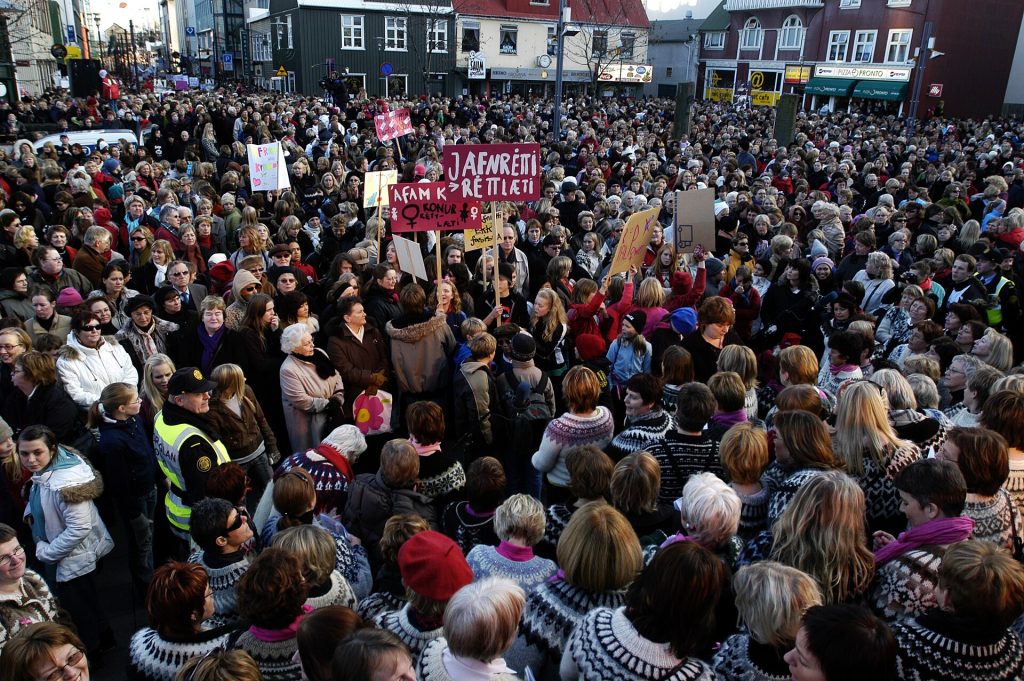
Around 90% of Icelandic women reportedly took part in the strike. About 25,000 people gathered in central Reykjavík, in a country with a population of roughly 220,000 at the time. That was not a symbolic pause. It was a national demonstration of dependence, and the country felt it immediately.
Men received something far more useful than a lecture. They received a demo. One day without women’s paid and unpaid labour. One small preview of a world where “but what do you even do all day?” turned into a logistical fire. Children had to go somewhere. Food did not appear. Care did not magically perform itself. The background became the foundation. Awkward, really, for everyone who had spent years calling the foundation “help”.
Iceland Didn’t Stop Because Women Were Nice. It Stopped Because They Were Necessary
The strike became known as Women’s Day Off, which sounds charming until you realise the phrase carried the energy of a brick through a window. The name looked softer than “strike”, but the effect was sharper. Women wanted to show that their work, both paid and unpaid, carried the economy and social life of the country. They succeeded because absence exposed value faster than gratitude ever could.
This mattered because the argument was never only about wages, although wages were absolutely part of it. The deeper fight concerned the definition of work itself. When a man leaves home to earn money, the system recognises productivity. When a woman raises children, feeds people, cleans, remembers, plans, soothes, schedules, organises and holds the emotional scaffolding of a household together, the system often calls it natural.
Convenient. Very elegant. Very “we built civilisation” from people who could not find the baby’s socks without asking their wife.
When women do something for free, society loves to call it love. When the same task gets attached to a salary, suddenly it becomes a profession, a contribution, a career and preferably something with a pension scheme. That is the scam hiding in plain sight.
The Icelandic strike did not turn the country into a feminist paradise overnight. History rarely behaves like a Disney film after therapy. Yet the day changed the country’s imagination. A year later, Iceland passed legislation on equal rights. In 1980, Vigdís Finnbogadóttir became the first woman in the world to be democratically elected as president. Nobody should read that as a fairy tale where women walked out once and won everything. A better reading is this: one day can alter national consciousness when it makes the truth too visible to politely ignore.
The Problem Didn’t Vanish. It Put On Better Clothes
The funniest part – and by funniest, I mean tragic in a way that requires sarcasm for basic survival – is that Icelandic women had to strike again in 2023. Women across the country, including Prime Minister Katrín Jakobsdóttir, took part in a national strike against unequal pay and gender-based violence. Schools, shops, banks, public transport, hospitals and hotels were reportedly affected. Organisers encouraged women and non-binary people to refuse both paid and unpaid work.
Let us enjoy the absurdity for one second. Iceland has often been presented as one of the most gender-equal countries in the world, and yet women still had to say, “Lovely rankings, darling, but reality is still in the kitchen holding a bill.” That is the thing about progress. It loves a press release. Life, unfortunately, asks whether anything actually changed in the home, the workplace, the wallet, the body and the bedroom.
Modern patriarchy does not always say, “women should stay silent” anymore. It has learned better manners. Now it says, “Of course you can work”, then quietly leaves women with the second shift at home. It says, “We believe in equality”, while still expecting women to remember birthdays, book appointments, monitor everyone’s feelings, track the children’s school needs and know why he has been “off lately” without turning it into a big thing. So women gained access to paid work, but not always freedom from unpaid servitude. Progress arrived with a hidden subscription fee.
Charming.
Iceland Was Not A One-Off. Women Already Knew Where The System Hurts
Iceland was not the only country where women tested what happens when they withdraw their labour. Switzerland saw a historic women’s strike on 14 June 1991. Around half a million women took to the streets under a slogan often translated as: “If women will, everything stands still.” That strike came ten years after gender equality had been written into the Swiss constitution, because paper equality had not become equal pay or equal life.

Spain carried the same logic into 2018 under the slogan “If we stop, the world stops.” The feminist movement organised a 24-hour strike across paid work, education, care and consumption. That scope matters. If women only stop office work, the world can pretend the issue belongs neatly to the labour market. When women stop care, housework, shopping, education and daily logistics, society suddenly sees that women’s labour does not fit inside one tidy category. It is infrastructure.
That is why this story is not a cute historical curiosity. It is not a sweet little moment from the feminist archive where we clap, post a black-and-white photo and return to the laundry. The point still breathes because the world still uses women’s work, then pretends the work happened by itself.
Homes run themselves. Children raise themselves. Relationships repair themselves. Elderly parents arrange their own care. Male careers build their own support systems. Dinner lands on the table through divine intervention. Calendars remember birthdays. School emails answer themselves. Emotional labour floats in like a scented candle.
Of course. And a unicorn packed the lunchboxes.
They Don’t Fear Women. They Fear A Day Without Us
The biggest lie is that women want a war with men. Most women do not want war. Many simply want to stop being the unpaid maintenance department for a world that keeps asking why they look so tired.
If that feels like war, perhaps the system has grown too comfortable with our surrender.

Women’s strikes reveal a brutal truth: women do not always need to shout to show power. Sometimes power begins when women stop managing the household, the children, the calendar, the emotional weather and the invisible labour that lets everyone else pretend they are self-sufficient.
Then panic arrives, because suddenly “help” reveals itself as an operating system.
That is why the headline matters. Men said women did nothing. Then women did nothing. The sentence works because it exposes the whole fraud. If women’s work was truly small, natural, easy and optional, one day without it should not have mattered. Yet it did matter. The country slowed. Institutions strained. Men brought children to work. Public life met the private labour it had spent decades ignoring.
History does not always need a grand theory. Sometimes it only needs one day where women do exactly what they were accused of doing.
Nothing.
Only then does everyone discover what that nothing was worth.
Sources And Further Reading
Tavaana: Women’s Day Off, Iceland 1975.
https://en.tavaana.org/womens_day_off_iceland/
Global Nonviolent Action Database: Icelandic women strike for economic and social equality, 1975.
https://nvdatabase.swarthmore.edu/content/icelandic-women-strike-economic-and-social-equality-1975
AP News: Women across Iceland, including the prime minister, go on strike for equal pay and no more violence, 2023.
https://apnews.com/article/iceland-women-strike-equal-pay-970669466116a2b1a5673a8737089d46
SWI swissinfo.ch: 25 years of the women’s strike, Switzerland 1991.
https://www.swissinfo.ch/eng/swiss-politics/25-years-of-the-women-s-strike_june-14-1991-a-historic-day/42219810
Campillo, I. (2019): “If we stop, the world stops”: the 2018 feminist strike in Spain.
https://www.tandfonline.com/doi/abs/10.1080/14742837.2018.1556092
Image credit: “Kvinnostrejk i Reykjavik (5)”, Johannes Jansson/norden.org, via Wikimedia Commons, licensed under CC BY 2.5 DK.
https://commons.wikimedia.org/wiki/File:Kvinnostrejk_i_Reykjavik_(5).jpg

.jpg)